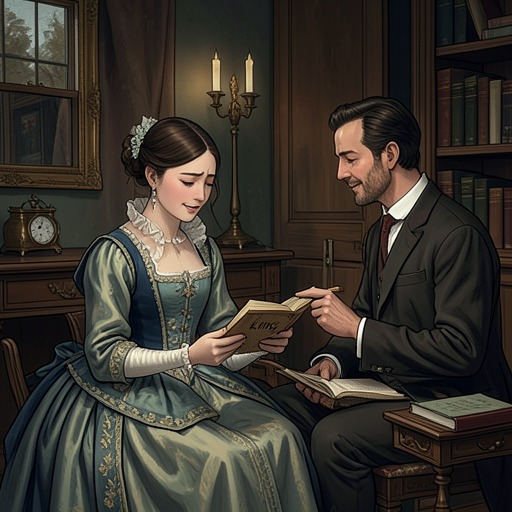
Love is blind
Henry V“Love is blind” is a proverb turned into a small negotiation between King Henry V and the Duke of Burgundy. The exchange tests what blindness means: an excuse for people who do not see the consequences of yielding, a force that makes them yield, and a condition King Henry V hopes will serve his courtship. Its wit rests on the tension between love as involuntary power and love as a strategy that can be deliberately used.
The Expression in Conversation
The proverb arises after a remark about the difficult condition a maid would have to accept. King Henry V says, “Yet they do wink and yield, as love is blind and enforces.” The wording joins apparent choice to compulsion: people “yield,” but love also “enforces.” The image of winking suggests a willing refusal to see, while the verb that follows makes love seem to exert pressure of its own. The expression therefore does not simply say that lovers overlook flaws; it presents love as both a failure of perception and a power acting on those who love.
The Duke of Burgundy answers by drawing out the ethical consequence of that failure: “They are then excused, my lord, when they see not what they do.” His reply shifts the proverb from observation to judgment. If lovers cannot see what they are doing, their blindness might excuse their conduct. The exchange leaves the excuse slightly unsettled, however: the earlier image of people who “wink” implies some participation in their own not-seeing, even as love is said to enforce it.
Blindness as Tactic
King Henry V turns the moral exchange toward the future. He says, “This moral ties me over to time and a hot summer; and so I shall catch the fly, your cousin, in the latter end and she must be blind too.” The insect image makes courtship playful and strategic: he casts himself as the one who will catch, and Burgundy’s cousin as the prospective catch. The seasonal delay is part of the plan; he proposes to wait until the latter end of a hot summer rather than treat the proverb as an abstract maxim.
The phrase “she must be blind too” makes the proverb useful to the speaker. Blindness first explains why lovers yield and may be excused; now it becomes a condition King Henry V hopes will help his intended courtship succeed. The shift does not establish that the cousin is already in love or that she will accept him. It shows instead how readily the language of involuntary love can be recruited for a hopeful, self-interested design.
A Reversible Proverb
The Duke of Burgundy replies, “As love is, my lord, before it loves.” His answer compresses a paradox into a reversal of timing: love is blind even before it has begun to love. The remark extends the proverb rather than merely repeating it, making blindness a precondition of love as well as one of its effects. In the exchange, the saying moves from a general claim about lovers to a teasing prediction about a particular courtship, while leaving its central ambiguity intact: not seeing may excuse a choice, but it may also be what makes the choice possible.